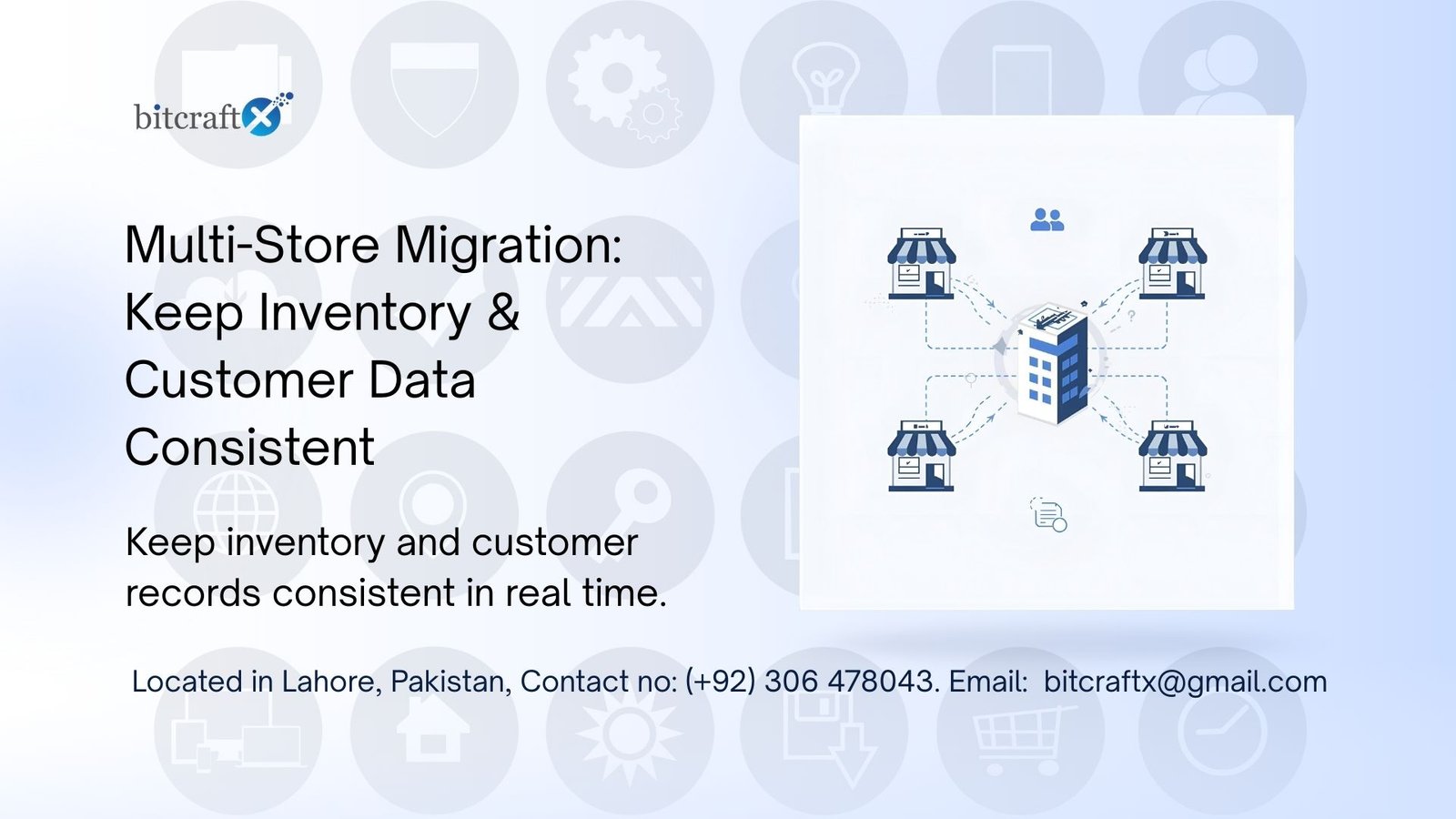
Migration is a major operational shift for brands operating multiple e-commerce stores. Years of independent growth can lead to inconsistent catalogs, integrations, and workflows. During migration, the real complexity is maintaining clean inventory and customer data while the business remains active and orders continue to flow. This is why multi-store migration requires a unified data strategy, supported by a reliable e-commerce sync to maintain real-time accuracy. Common Multi-store Complexities Because all stores are usually still active while the migration happens, the operational complexity is multiplied. Inventory changes every minute. Customers continue placing orders. Payments keep flowing. There is no natural “pause” button. This is where e-commerce sync becomes essential to maintaining accuracy from start to finish. Why Inventory Consistency Must Be Protected During Migration Inventory accuracy determines whether businesses ship on time, prevent overselling, and maintain customer trust. During multi-store migration, inventory can become inconsistent quickly if the data flow is not controlled. Several of these triggers cause this to happen, such as: Inventory is a changing asset. Poor inventory sync during migration leads to stock mismatches, which may require manual corrections, delays in orders, and a deteriorated customer experience throughout every touchpoint. Customer Data Consistency is Equally Important Businesses often do not realize how complex customers are until they try migrating information across multiple stores. However, it is within customer data that most inconsistencies are found. A brand might discover the same person was listed three times in three stores, with marginally different spellings of their name, outdated addresses, and variations in email formats. Customer inconsistencies impact: E-commerce sync ensures that the merging, normalizing, and maintenance of customer records during a multi-store migration do not disrupt ongoing customer activity. Unified Data Model: The Role It Plays A key precursor to successful multi-store migration is the definition of a unified data model by the business before any technical steps begin. One unified model will govern how products are structured, how SKUs are standardized, how variations are represented, how customer fields are organized, and how categories map across stores. This model becomes the reference point of the new system. It determines: It makes a set of siloed stores into one coherent ecosystem. On migration, it removes all the noise caused by legacy systems and ensures that the new platform is initiated with cleaned-up and integrated data. E-commerce Sync in Multi-Store Migration: Why It Matters E-commerce sync keeps everything in real time during the whole migration process. Stores seldom go into cold storage. Along with streaming orders, updating profiles, and changing inventory, the synchronization bridges between the old and new systems. Without this step, organizations often face post-migration challenges that require weeks to resolve. Building a Modern Migration Strategy Modern e-commerce operations depend on accurate real-time data. Multi-store migrations must follow that same standard. Migrating multiple stores without a sync-first approach forces the business to rely on outdated exports and manual reconciliations, something that does not scale and introduces risk. A better approach is to consider migration as a type of data transformation rather than a file transfer. Such an approach will guarantee: All shops migrate with ease to the new platform. This approach reduces the after-migration operational burden on warehouse teams, customer support, and marketing teams. Instead of spending weeks correcting data, the business can focus on growth, performance, and platform capabilities of the site. Conclusion Migrating multiple stores is no small task, but with the proper data strategy, it becomes an opportunity to advance accuracy, consolidate systems, and elevate customer experience. The two main pillars that define whether multi-store migration will strengthen operations or truly disturb them are inventory consistency and customer integrity. In unifying data, maintaining real-time ecommerce sync, and transitioning to a structured model, businesses can migrate multiple stores with confidence, maintain continuity across every channel, and start operating on more solid, scalable ground. Book a Demo